 Insurance
 AI
 Health Care
 Construction
 Financial Services
 Mobile
 Real Estate
 Project Management
 Challenges
Claim adjusters inspect the whole site: the roof, gutters, siding and windows outside, and the rooms, ceilings, walls and floors inside. Each area has its own section of the form, with measurements, counts, damage types and written notes. Adjusters fill these forms while on a ladder, in an attic or crawl space, or moving room to room with a camera and tape measure in hand. Typing on a phone in those conditions is slow and error-prone, so notes were often written up later from memory. Many loss sites have weak or no mobile signal, or no power after a storm, which rules out cloud speech and AI services. Recordings inside a policyholder's home also raise privacy concerns if they are sent to third-party servers. Finally, a general AI model tends to "fill in" values that sound plausible but were never said. On a claim report, an invented measurement or damage type is worse than a blank field.
 Solutions
Rheal built VoiceScribe on Apple Intelligence, the AI built into recent iPhones. Apple's on-device speech recognition turns the adjuster's dictation into text, and Apple's on-device Foundation Models language model reads that text and fills the form. Both run entirely on the iPhone, so the solution works offline and keeps every recording private. It supports five kinds of fields:
- Short text summaries or word-for-word notes
- Numbers, with optional units and allowed ranges
- Single choice from a list
- Multiple choice from a list
- Yes / No
The solution is delivered as a Flutter plugin that drops into an existing claims app. Forms are described in Dart or loaded as JSON from the backend, so new forms and sections, from exterior to interior, need no changes to the native iPhone code. Every filled value is checked against what was actually said, and the adjuster can review and correct any field before saving.
Key Features of the Solution
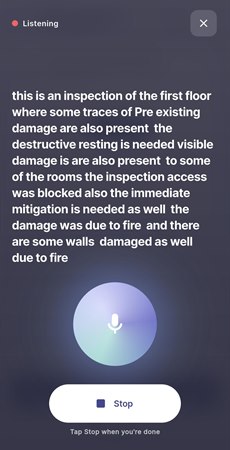
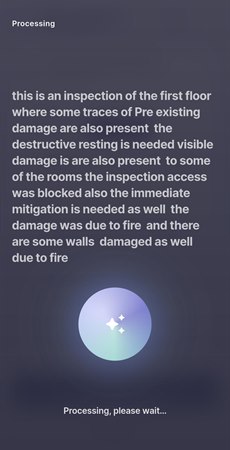
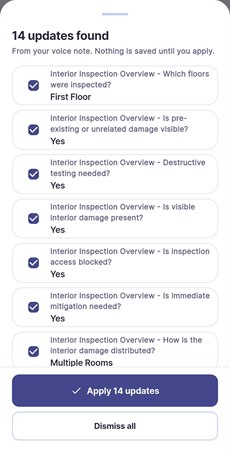
- Record and Stop: One button starts and ends a dictation. A live transcript shows the words as they are heard, and the form fills the moment the adjuster stops. Dictation can fill one section, such as a single room, or the whole form.
- Fully On-Device and Offline: Speech recognition and form filling both run on the iPhone. No internet, cloud account or API key is used, and no audio or text leaves the device.
- Never Invents Values: A number is kept only if it was spoken. A choice is kept only if its name or a synonym was said, and "no blistering" does not count as blistering. Summaries are built only from words that were said.
- Understands Field Language: Each form carries its own vocabulary and synonyms, so "cupping" fills Cup Curl and "five by ten" fills 5x10. Misheard trade words, such as "shields" for "shingles", are read as the adjuster meant them.
- Handles Natural Speech: Corrections like "five by five, no, make that five by ten" record only the final value. Filler words and asides such as "let me move the ladder" are left out of the notes.
- Hand Edits Win: Anything the adjuster types or taps is locked and never overwritten by a later dictation. Fields filled by voice are highlighted for quick review.
- Any Form, Any Size: Forms are defined in Dart or JSON with sections and fields. Large forms and long dictations are split automatically into pieces that fit the on-device model, then merged back together.
- On-Phone Testing: Sample dictations can be run on a real iPhone, with a pass or fail report for every field, so new forms are checked before they reach adjusters.
 The Result
Rheal's solution lets adjusters complete each part of a site inspection, from a roof slope or the gutters to a water-damaged kitchen, by simply describing it while their hands stay free for the work. A single messy, natural dictation, complete with hesitations, corrections and side remarks, fills measurements, counts, damage findings and clean summary notes in one step. Because everything runs on the iPhone, it works at loss sites with no signal or power, has no per-use cloud costs, and keeps policyholders' details private. The never-invent checks mean the claim report contains only what the adjuster actually said. Since forms are defined as data, new inspection types and sections can be added from the backend without a new native release. As a result, adjusters finish reports on site rather than from memory later, and claims are documented faster and more accurately.
Beyond Insurance
Because forms are fully dynamic, voice form filling isn't limited to insurance field work: it can speed up any job where people fill in forms.